
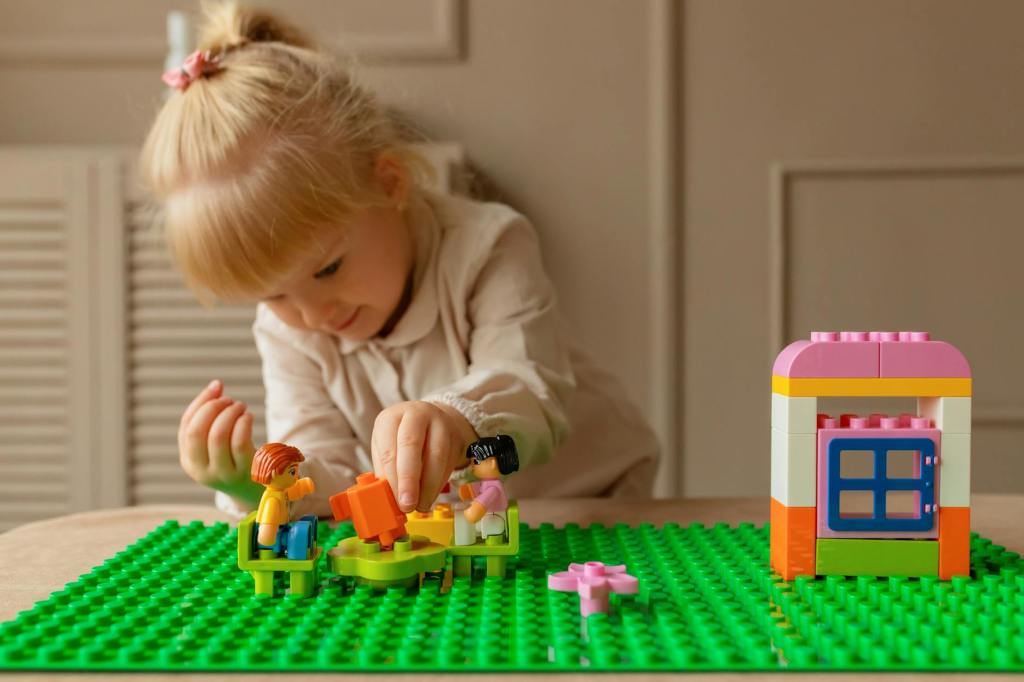

Read on for some great educational and fun ways to use Lego at home.
If your children are anything like mine, they will absolutely LOVE Lego! So what better educational resource to support learning than one they enjoy and want to engage with! There is a quote which I love (though I forget where it comes from…)
The things you learn without joy, you will easily forget.
How true it that?!
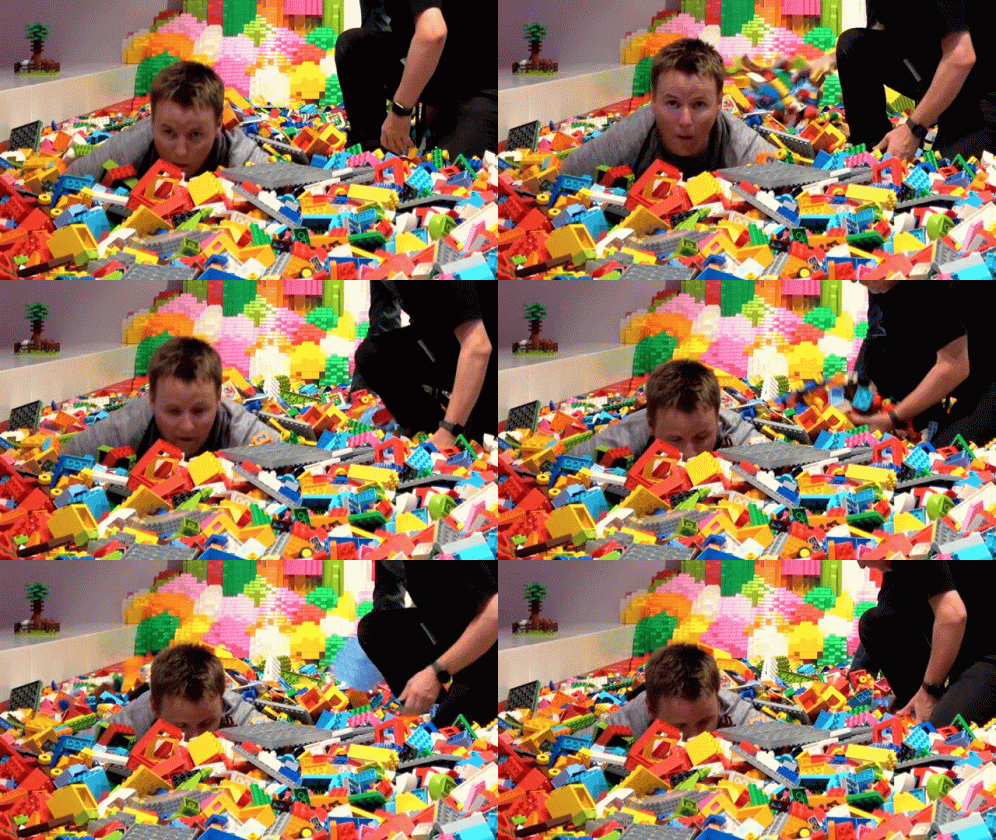
The tips I’m sharing here will probably work better with younger children, but could be adapted to suit older children too. Please share your pictures and ideas on the comments section!
(And, just an FYI, for those of you who are interested in more educational advice, please click here for more of my content Learning and Education)
My favourite kind of Lego is the free choice Lego, as it is fantastic for encouraging creativity and has so many different uses. Most of my activities will work best with this type of Lego, although the Lego kits are great too.

Fine motor skills
Fine motor skills
Lego is a great way for children to develop their fine motor skills. This means that by using Lego your child will build strength in their hands, fingers and wrists, which will have huge benefits for their writing! They will be building stamina and coordination, as well as the physical grip strength to actually hold a pencil comfortably. This tip needs nothing more than allowing your child to have regular access – woohoo!

Mindfulness
Mindfulness
Have you ever noticed how peaceful and focussed your child seems when they’re fully immersed in constructing with Lego? This is a great opportunity to teach children about mindfulness, and the benefits of appreciating the moment.
Literacy
Reading and writing
Lego is also great for practicing writing… by building writing! For example, you can practice building letters or words on a baseboard, such as high frequency words or ones which your child finds tricky to spell – the best type of spelling practice! You could also get your child to write words on individual Lego pieces, and use them to build sentences (or letters into words). This would work well for a range of activities, for example adding exciting adjectives into a story sentence, or practicing adding conjunctions like ‘because’ to build longer sentences.
For reading practice, you could try to sort the sentence words into the right order, or build silly sentences. You could even just encourage your child to read by choosing a Lego themed book, or by using my favourite book, The Lego Ideas Book. You could practice sight reading by hiding some words your child finds difficult on Lego under a blanket, and challenge your child to read it quickly before the blanket lowers!
Honestly, the possibilities are endless!
(For more advice on writing, please check out this article How to encourage your child to WANT to write)

Mathematics
Maths
There are so, soooooo many mathematical ways to use Lego!
For example, you could develop the idea of sorting, by creating groups of colours, size, length, number of dots, or even how they could be used (eg ‘blocks that are good for building trees’).
There are also lots of number exploring activities you could try. You could teach number order, by writing numbers on the side of the blocks and practicing putting them in order or finding the missing number. You could even practice times tables, by only creating something from the numbers which appear in the times table of choice. Counting is also a rather obvious use here, and counting the blocks is a fun and low pressure way to practice stable number order.
Addition is also a fun one to practice using Lego, and it is easy to find ways to talk about different amounts in each group of blocks and the total amount. The same with subtraction! You could also compare numbers in groups of objects to find the difference, such as the amount in the pile of reds compared to the pile of blues – which has more? Less? How many more or less? How do you know? You could practice division, by sharing out the blocks between your child’s favourite toys. Can they be shared equally? Is there a remainder? This also works for finding odd and even numbers, as you can notice which blocks make a pair and which don’t. You can even practice measuring, area and perimeter through Lego.
I think what I am trying to say is… the only limit with Maths and Lego is your imagination! The opportunities are endless!
(Here are some more playful education ideas: Home schooling: educational play ideas for when ‘formal’ fails)

Creativity
Developing creativity
Lego is amazing for creativity! And especially if you choose the free choice version! You can make anything and everything from Lego. You could encourage your child’s creativity by setting them simple creative challenges, such as making a structure in a certain style, using a certain type or amount of Lego bricks, or building their own superhero creation. You can even use Lego to film stop motion videos with a smart phone, or to create video stories using their models. There are even Lego art sets where children can make art pieces, and Lego dots, which offer a unique Lego experience.
(For related information on creativity, please read How to nurture your child’s creativity)

Personal skills development
Personal skills and character development
There’s no doubt that Lego is fun and great for relaxing. However, at times it can be frustrating too! Think model breakages, pieces that are stuck together, and being unable to find the perfect block. These will certainly test a young child’s patience! Yet, this actually brings great opportunity to learn, and develop resilience and perseverance in the face of adversity and challenge. In these scenarios you can model staying calm and trying again, and offer praise when they’ve tried hard to do something. A phrase which acknowledges their frustrations but encourages them to keep going might help, such as ‘I know that’s really frustrating for you, as you spent such a lot of time and effort on your model. Let’s take a minute to breathe, then see if we can make it even better than before!’.
(Further information on developing resilience can be found here: How to build child resilience during coronavirus)

Cooperation and negotiation with others
Cooperation and negotiation with others
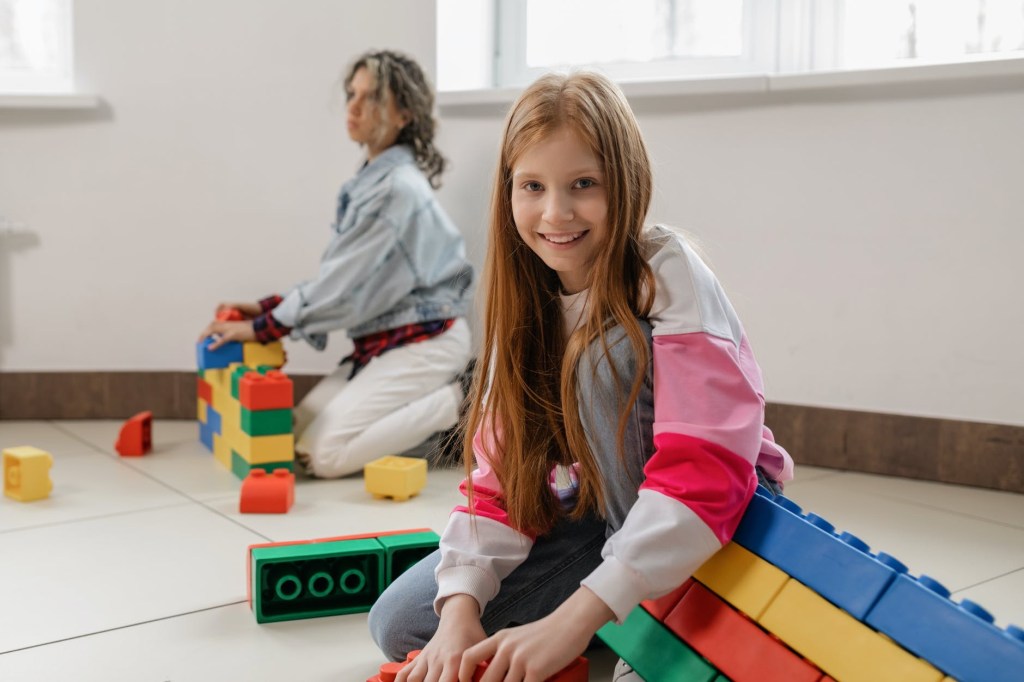
Lots of children enjoy building Lego with others, and I can’t count the amount of times we have had a huge pile of Lego on the floor whilst we all build together (here’s an extra tip if you do this too – invest in a storage mat to make tidy up time easier. You’ll thank me later!). However, whenever resources need to be shared, there is the potential for disputes to arise. By building Lego with others there will be plenty of opportunities to develop the skills of negotiation and communication with others through sharing resources and negotiating ideas.
(For support with encouraging sharing skills, you may wish to read this: How to encourage your child to share)
So there you go, lots of ways which using Lego can support your child’s learning and development. I hope it helps! If you need any advice or support then please feel free to leave a comment. Thank you so much for reading ❤️
Love Heather x
One response to “Educational ways to use Lego when homeschooling young children”
-

[…] on Lego […]
LikeLike
- Why Anxiety and Low Confidence Affect Learning — and What Parents Can Do
 As parents, it can be heartbreaking to watch your child struggle with schoolwork — not because they can’t do it, but because anxiety or low confidence holds them back. Many bright, capable children begin to doubt themselves after a few negative experiences in the classroom, and this can quickly affect both their academic progress and… Read more: Why Anxiety and Low Confidence Affect Learning — and What Parents Can Do
 - The Benefits of Tuition for Children — Why It’s Worth the Investment
 As parents, we all want our children to feel confident, capable, and happy in their learning. Tuition for children isn’t just about catching up or boosting grades — it’s about helping each child reach their full potential, both academically and emotionally. Whether your child needs a little extra support, more challenge, or a confidence boost,… Read more: The Benefits of Tuition for Children — Why It’s Worth the Investment
 - 10 Simple Tips to Improve Your English Speaking Skills Every Day
 Want to speak English more confidently? Discover 10 practical tips to improve your English speaking skills every day. Perfect for learners who want fluency fast—with guidance from a qualified English teacher.
 - How to Create Healthy Boundaries for Your Child: A Parent’s Guide to Raising Confident, Respectful Kids
 Creating healthy boundaries for your child isn’t about control—it’s about connection, guidance, and helping them feel safe. When children know their limits, they’re free to explore, learn, and thrive.
 - How to teach the concept of time to young children: A guide for parents
 Understanding the concept of time is a huge developmental milestone for young children—and it doesn’t happen overnight. As adults, we rely on time constantly, but for children, time is an abstract idea that requires support, experience, and practice to fully grasp.
 The Growing Way Tuition: Home page
Leave a comment